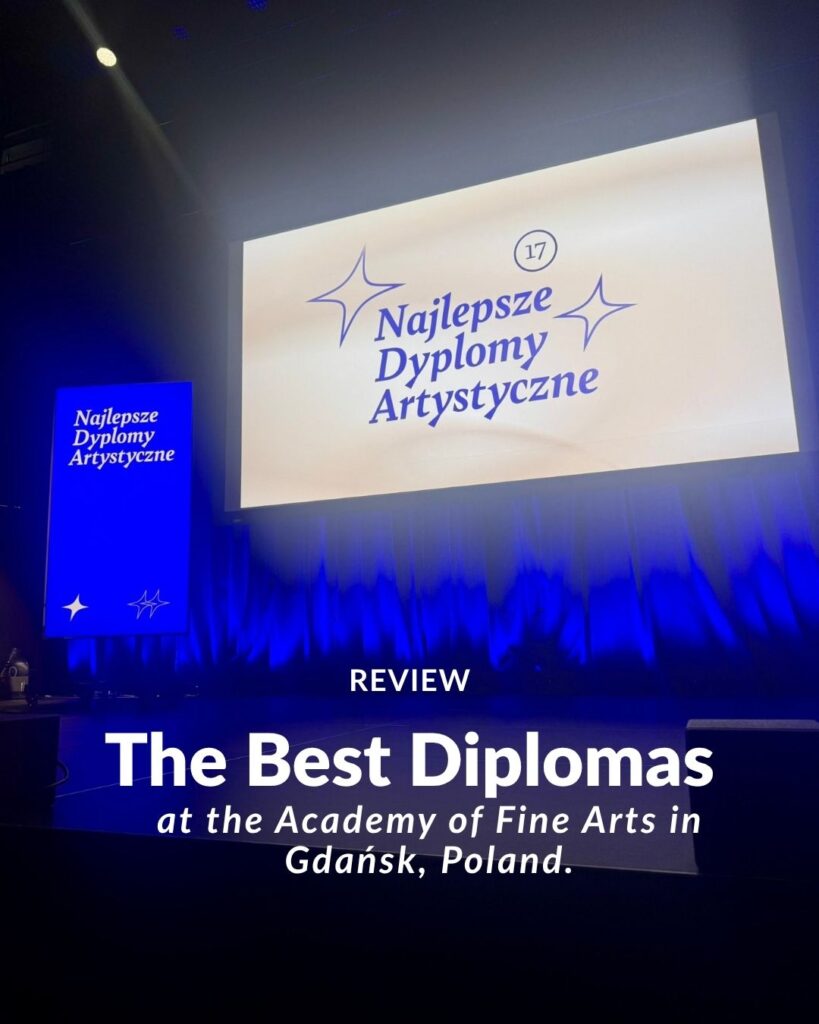
This isn’t going to be a regular review. Maybe a review, but not of an exhibition this time. More like a review of my life. I know, I know. Sounds cringe, but I guess that’s fitting, since this account was meant to be just an archive of my professional development.
Recently I was invited to be on a jury as a critic for the Best Diplomas at the Academy of Fine Arts in Gdańsk, Poland. The whole thing needs a bit of explaining, because the Polish art education system has its own vocabulary. Here’s a short glossary:
- Akademia Sztuk Pięknych (ASP) – Academy of Fine Arts, basically the only art university in Poland, with 8 separate academies in different cities. Imagine all of the University of the Arts London’s colleges, but spread across the whole of GB and ten times more competitive.
- Dyplom (Diploma) – the final artwork/project, plus an aneks, plus a written text about your practice.
- Aneks (Annex) – an extra work of art in a different medium than the one you studied. (Why? No idea. I think it’s something like the final piece of an extra module for the BA degree.)
- Pracownia – the closest English word is probably “studio,” but it’s really more about the relationship between student and master, and the respect owed to your superior. In Poland, your teachers, lecturers, mentors, and supervisors are not your friends whom you’d call by their first name. It means you studied under a particular master’s eye. So one could say: “This artist emerged from Professor X’s studio,” or something even more official: “He trained in Professor X’s atelier.”
One last thing: we love titles in Poland, and we’re very proud of them. It’s rare in the UK to hear that someone has done any post-PhD training. In Poland it seems almost mandatory to be working toward a higher academic title at all times if you want to keep afloat. Maybe I’m exaggerating, but I genuinely struggled to remember people’s names, because sometimes the first name showed up in fourth or fifth position.
It was strange having to unlearn this respectful way of speaking to my superiors once I moved to the UK, and now, going back, I sweat over whether I’m overstepping boundaries by forgetting someone’s status. Calling someone “Mr First Name” or “Mrs First Name” felt oddly over-familiar.
Now that you roughly know what these things mean in Polish art education, picture teen Sophie sitting in a park with her grandma, flipping through a newspaper. I remember being fifteen or sixteen, reading an article about ASP and wondering which high school I’d need to apply to in order to get there eventually. And I knew it was already too late for me. No one in my family worked in the arts, public education never even planted the idea that you could do more with art than glue a collage together out of colourful newspaper, and I didn’t have a portfolio because I wasn’t a Picasso. You can’t get into ASP if you can’t draw realistically, and in my case that hasn’t changed. But I also had no idea what I actually wanted to do in art. Becoming an artist seemed like the only way in and the only thing you could even do.
And then, for some mysterious reason, my parents allowed me to apply for a bachelor’s degree programme in fine arts. But it wasn’t until I was 20 that I learned there was a role called “curator.” My mind blew up. It felt like this profession I couldn’t quite grasp was exactly the thing I wanted to do.
So, armed with that huge unknown, I applied for a Master’s in Curating Contemporary Art and got in. After that, I did a bit of everything to survive in London’s art world, eventually became a full-time artist manager, and then decided to do a PhD in Art Criticism, all while speaking and writing about art only in English.
(Funny thing: working on my PhD made me feel like I could fit in alongside the long list of judges with proud post-PhD certificates I found listed on ASP’s website.)
Somewhere along the way I became friends with a few Polish people who also worked in the arts and lived in Poland, and that is a very important thing to flag as it makes a real difference. When I talk to art friends in the UK, we just drop in English words or phrases whenever it’s easier. So when the opportunities arose to talk about my own profession in Polish, it turned out it was genuinely hard.
Take the word “sustainable.” In English, you hear it constantly, and in many contexts it almost means “self-care.” In Polish, I can’t remember ever hearing “zrównoważony rozwój”. You can’t just absorb the feel of it the way you can in English.
And then, a few months ago, I was invited to judge the Best (NATIONAL!) Diplomas at the Academy of Fine Arts in Gdańsk. I know I would never have gotten that invitation if I’d stayed in Poland. My life somehow closed a circle. Or maybe opened one? We shall see.
Before I got there, part of me worried I’d be seen as someone who shouldn’t really have a voice in that competition, since I wasn’t totally sure what the rules of the Best Diplomas even were. Surprisingly, though, the others on the Critics’ Commission, including Michalina Sablik, Michał Borowik and Jacek Sosnowski, had similar reflections on which works stood out, and why. We looked closely at the presentation, materials and storytelling behind each piece. We decided to give the main prize to Mateusz Pecyna, with an honourable mention going to Piotr Lewandowski.
I also loved being on a panel discussion alongside other critics, Rafał Kamecki (Artinfo.pl) and prof. dr hab. Grzegorz Hańderek, Rektor Akademii Sztuk Pięknych w Katowicach, who brought diverse perspectives on how recent graduates can navigate in the art world and market. I truly learnt a lot from them.
However, what surprised me most was that only one graduate spoke to us after the awards ceremony, and no one messaged or emailed me afterwards. It seems to me that in the UK we’re much bolder about approaching people who work in the arts, or at least we know we have to, as otherwise our careers won’t move forward. I wonder if it’s partly because the UK has a constant stream of art events (openings, talks, you name it), and everyone keeps telling us that contacts are everything. Poland clearly doesn’t have that same density of events, so maybe approaching strangers is seen as a bit of a no-no. A true mystery.
I want to thank everyone once again for sitting through my endless Why? What for? Why? Who? Why? How? Why? Where? Why? When? Why? Why? Why? questions. It was a wonderful adventure!
The sentence “I hope to return and learn more about the art world in my home country!” seems so weird, but maybe that’s a good thing. I want to believe it’s because the contemporary art world in Poland is gradually opening up to new audiences and international visitors. It’s changed so much that I feel like I have to rediscover it all over again.