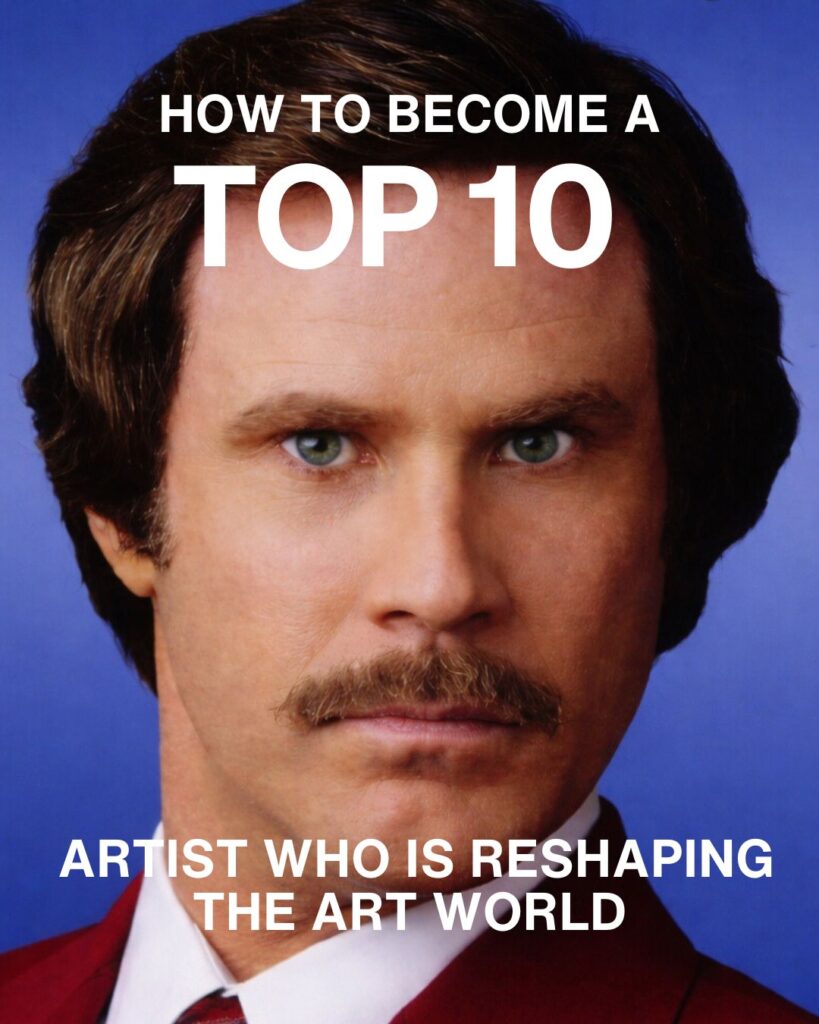
First, stop thinking about your art. Think about your brand.
Think about how you appear, not what you make. About how easily you can be searched, summarised, categorised, and circulated. Learn to translate your practice into keywords. Reduce uncertainty. Eliminate contradiction.
Ask yourself practical questions: Are you legible at thumbnail size? Does your face photograph well in bad lighting? Can your work be explained in one sentence without unsettling anyone too much?
This is how selection begins.
Most-searched. Most-recognised. Breakthrough. Game-changing. Top-selling. Most powerful. Most influential. One to watch. On everyone’s radar. Artists to know. Shows to see. Booths to visit. Collectors to follow. Curators revolutionising the scene.
These words circulate faster than artworks ever could. This is the vocabulary you must master. The grammar of relevance.
If this reads like advice, it is because the system already speaks this way. The tone is instructional, but the intention is diagnostic. I am not actually going to tell you how to get there. If a critique of this system does not interest you, you can swipe up now.
So let’s define the object of this critique. Rankings are concrete editorial products, developed by magazines, platforms, museums, galleries, and market-facing institutions, and circulated through websites, newsletters, annual issues, and Instagram carousels. They promise orientation, authority, and relevance. They are easy to find, easy to share, and increasingly hard to avoid.
Rankings generate a constant, low-grade anxiety, a curated sense of FOMO. The feeling that you are always arriving too late, always missing something essential. As if you are not wealthy enough to belong, not impactful enough to matter, not relevant enough to be seen.
They reduce people to categories, demographics, and movements. To gender, geography, and identity. To a single word that pretends to summarise years of thinking, labour, risks, wins and failure.
They also make you feel replaceable. Disposable. Small. In a culture obsessed with the next big name. They are perfectly designed for fast consumption. The art world, supposedly invested in depth and complexity, has quietly adopted the same ranking logic as lifestyle media and trend forecasting platforms. This is the attention economy at work.
We tend to trust platforms more than personal experience. A shared post feels like validation. Judgement is outsourced to algorithms, editors, and branded authority. It becomes easier to trust a carousel than to trust your own eyes.
When artists are compressed into a Top 10, their practices turn into content. Their biographies collapse into hype. Their trajectories freeze in time.
The list promises momentum, but it also imposes a deadline. Once you are one to watch, what happens when the watching ends?
And what happens when artists change? When their work changes? When it is no longer about what it was supposed to be about?
What if you were once framed as the most influential working-class young abstract painter from the Middle East? But then you get accepted by a top art university. You turn 35. You start making sculpture. You move West. Are you now less important? Less urgent? Less interesting? Simply less useful to the headline?
When these lists drop, the same questions follow. What actually happens to these people once they are announced as the new hot takes?
Rankings are accessible, digestible, shareable. They rarely explain why these artists matter beyond the headline category. Video. Feminism. LGBTQ+. Black. Ecological. Vast practices reduced to a single keyword.
This is the ephemerality of digital recognition disguised as progress. Lists simulate constant discovery while making depth almost impossible. The format never changes. Sometimes the faces do. Sometimes they do not.
But what does it actually mean to these people once they are announced as the new hot takes? Does it materially affect their careers? Is this selection as meaningful as a serious review of their solo show? Can it go on a CV? Who is this even for?
And what exactly does transforming the art world mean? How does it manifest itself, and how can it be measured? Through sales, museum acquisitions, institutional power? Are these artists dismantling mega-galleries or merely circulating within them? Most of the time, there are no links, no exhibitions, no context next to the names. There is often no explanation of the work itself, only a face and their name. And maybe a medium they use.
This confusion extends beyond artists. Top 10 shows. Top 10 museums. Top 10 fairs. Everything flattened into a number, stripped of texture. This is how we are now told to approach art. Not to encounter it, not to admire it, not to fall in love with it, but to consume it. Quantity over quality. One sentence standing in for decades of work.
I am especially suspicious of the word reshaping. What is actually being reshaped, and for whom? If anything, the only visible change is the acceleration of circulation and the consolidation of attention.
And now we finally get to the most important question. Who decides who should be on this list? Who gets the polished portrait in a carousel? Who earns the sentence on ArtNews?
Who is that judge? How do they choose? And who even decides that this person will be the judge? Sometimes the gatekeeper is named. Sometimes not. As if anonymity makes power more neutral.
My favourite example is the Power 100 by ArtReview. They describe it as “an annual portrait of power in the art world”. I may be the only one who gets a bit of heebie-jeebies when the word “power” is used so confidently in relation to art, but the list has been running since 2004 and is widely treated as an authoritative map of influence.
Sooo… yeahhhhh… the portrait of power…
When I started researching this topic in August 2025, ArtReview’s “How we do it” section included the following explanation. They wrote that the 2024 list was “an attempt to fix a snapshot of how the art world really operates: who decides whose art gets shown, which subjects our institutions address, what type of art we get to see today, where we get to see it, and what barriers to accessing it are constructed or deconstructed”.
They also stated that the jury was anonymous so that its members could “freely pass judgement over their friends, colleagues, nonfriends and complete strangers without fear of reprisal or retribution”. As of 5 February 2026, this passage no longer appears in their User’s Guide.
This matters. Not because anonymity is inherently wrong, but because professionalism should not require secrecy. If anything, it demands accountability. When power is exercised while its mechanisms quietly disappear from view, neutrality becomes a performance rather than a principle.
What lists like this ultimately reveal is not how art works, but how power prefers to appear: objective, data-driven, inevitable. And nothing could be further from the truth.
Believe it or not, in the Power 100 list for 2025, Hans Ulrich Obrist, David Zwirner, Larry Gagosian, Ariel Emanuel & Simon Fox, Jay Jopling, Marc Glimcher, Emmanuel Perrotin, Peter Doig, Marina Abramović, and Tracey Emin are all still there. If you do not know who they are, that’s completely okay. You don’t have to. I mentioned them because they are the same curators, gallery directors, art fair owners, and artists who have appeared on this list with remarkable consistency since 2004. I am not exaggerating. I checked all of them.
This persistence is revealing. If a list claims to capture who is reshaping the art world, yet repeatedly returns to the same figures over two decades, then what is being documented is not transformation but consolidation. The gatekeeping remains intact, even as the language around it insists on change.
Perhaps the title of this post needs to be rephrased. Not “How to Become a Top 10 Artist Who Is Reshaping the Art World”, but “How Not to Become One”.
And in case you want to look through some of these lists, here are keywords and links to articles I collected in 2024 and 2025:
“Most-Searched”
https://news.artnet.com/market/the-10-most-searched-artists-2684582
“Under-recognised”
https://www.artnews.com/list/art-news/artists/under-recognized-artists-2024-rediscoveries-1234726628/
“Redefining collecting”
https://www.artnews.com/art-news/news/gen-z-art-collecting-continuum-2025-1234758630/
“Breakthrough”
https://www.artnews.com/list/art-news/artists/early-modern-women-artists-growing-interest-1234751187/to-market-to-market/
“Most powerful”
https://www.theguardian.com/artanddesign/2014/may/08/art-world-most-powerful-people
“Most influential”
https://artreview.com/power-100/
“Game-changing artist”
https://www.artnews.com/art-news/news/jasmin-hernandez-we-are-here-interview-1234582886/
“Disruptor”
https://news.artnet.com/art-world/game-changers-art-world-2016-708134
“Shaping the future of art”
https://www.artsy.net/article/artsy-editorial-black-collectors-shaping-future-art
“Top-Selling”
https://www.artnews.com/art-news/news/10-top-selling-living-american-artists-morning-links-1234754482/
“The artist to know”
https://www.nga.gov/stories/articles/15-lgbtq-artists-know
“Top 5”
https://www.artsy.net/article/artsy-editorial-5-emerging-art-capitals-watch-2025
https://www.artsy.net/article/artsy-editorial-5-pieces-list-design-miamiparis-2025
https://www.artsy.net/article/artsy-editorial-5-outstanding-artworks-liste-art-fair-basel-2025
“Top 10”
https://ubertrends.com/10-art-trends-shaping-the-future-of-creativity-in-2025/
“Top 12”
https://www.artsy.net/article/artsy-editorial-12-leading-curators-predict-defining-art-trends-2025
“Top 200”
https://www.artnews.com/art-collectors/top-200-collectors/top-200-collectors/
“The best artists in the world”
https://thombierd.medium.com/worlds-best-futuristic-artists-rivas-chung-tereshkova-liebenow-schaub-yoon-devar-kim-101b6dd2c099
“Shows to see”
https://www.artnews.com/list/art-news/news/summer-2025-top-art-museum-exhibitions-shows-1234743231/
“The best art fairs”
https://luxurylondon.co.uk/culture/art/the-best-art-fairs-and-events-in-london/
“The best booths”
https://www.instagram.com/p/DOgWXSkk2Nw/?hl=en&img_index=1
“The top 10 women artists…”
https://www.nga.gov/stories/articles/10-contemporary-women-artists-know
“Revolutionizing the scene”
https://www.artsy.net/article/editorial-the-history-of-video-art-in-a
“Visionary voices”
https://www.amazon.co.uk/2025-Visionaries-Artists-Creative-Catalysts/dp/840962897X
“Names to know”
https://www.linkedin.com/pulse/5-names-know-global-art-scene-industrie-africa-65izf/
“On everyone’s radar”
https://hearhear.substack.com/p/6-under-the-radar-artists-to-know
https://www.artsy.net/article/artsy-editorial-5-artists-radar-june-06-03-24
“Most famous artist”
https://www.contemporaryartissue.com/the-20-most-famous-painters-today-you-should-know/
“The biggest influencers in arts”
https://news.artnet.com/art-world/the-biggest-influencers-2411373
“One to follow”
https://blog.artsper.com/en/a-closer-look/contemporary-art/10-transgender-art-artists/
“One to watch”
https://www.artsy.net/article/artsy-editorial-10-artists-to-watch-at-liste
“Must see”
https://www.artsy.net/article/artsy-editorial-10-must-see-art-basel-2025