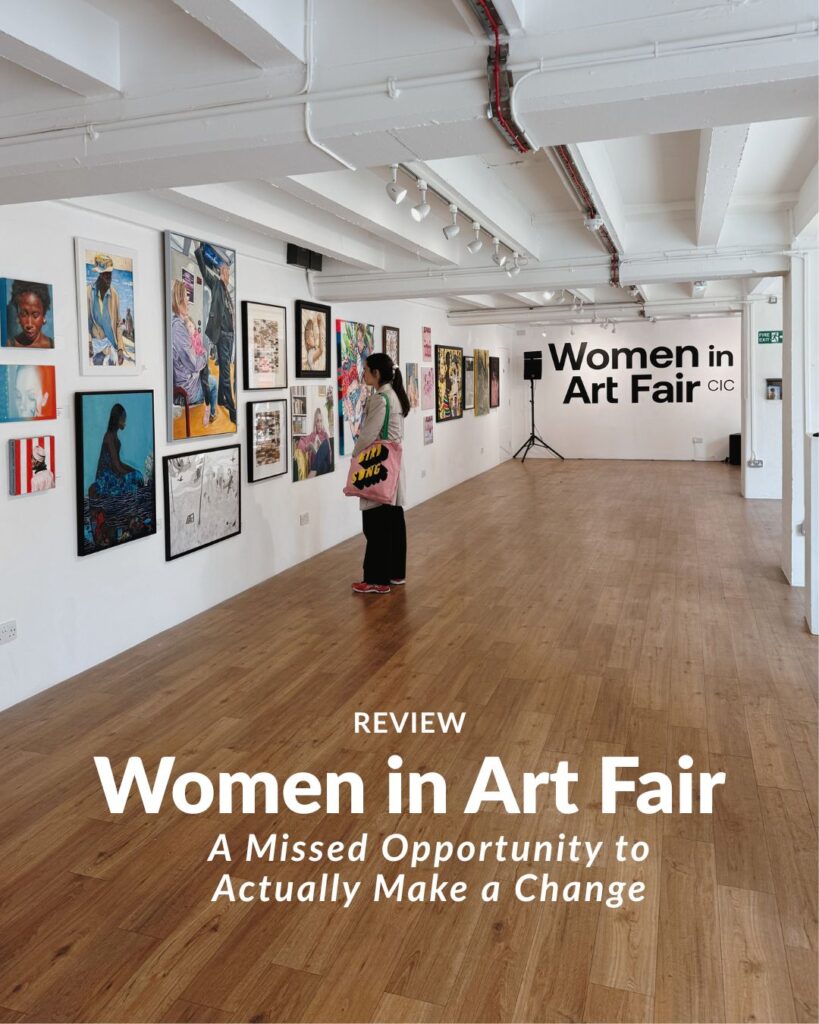
Women in Art Fair is a London-based not-for-profit art fair dedicated exclusively to women artists and those identifying as women, operating as a CIC, engaging directly with one of the art market’s most persistent distortions: the systemic undervaluation of women’s artistic practice. That’s the mission, as stated in the 2026 catalogue. I want to take it seriously because it deserves to be taken seriously, which is precisely why I left this year’s edition more frustrated than I expected to be.
Let me be clear before I go further. I want WiAF to exist. I want it to thrive. The conversation it claims to host, about the structural under-representation of women in the art market, is one of the most necessary conversations happening in the sector right now. Which is why I think it’s worth asking, honestly and out loud, whether the fair as it currently stands is hosting that conversation, or whether it has quietly drifted into hosting something else.
So let me start with what I counted. The 2026 catalogue includes the lists of 73 works by 61 artists. Of those 73 works:
- 51 are paintings (44 oil, 7 acrylic): 70% of the fair
- 4 are drawings: 5%
- 7 are photographs: 10%
- 5 are prints or collage: 7%
- 5 are textile or mixed-media wall pieces: 7%
- 8 are sculptural or ceramic: 11%, made by just 6 artists
Zero moving image. Zero poetry. Zero sound. Zero performance. Zero installation. Zero spoken word. Zero work that requires time, rather than a glance, to experience.
I understand an art fair is an art fair. It is not a biennale, not a museum, not a place built for the most formally challenging work in the world. Fairs sell things, and what sells most reliably is something flat that fits over a sofa. I get it. But WiAF is not just any fair. It has framed itself as a corrective, a platform. It is registered as a Community Interest Company. And this is where I keep getting stuck.
How does a CIC work as an art fair? Community Interest Company should mean what it sounds like: community interest. And this is the category confusion at the heart of WiAF. Either it is a not-for-profit platform whose purpose is to build a conversation and a community around women in art, in which case the curation, the programming, and the medium range have to do the heavy lifting and sales follow, or it is a commercial fair that exists to move work made by women in which case it should drop the CIC framing and the inclusivity language and compete on those terms. Both are legitimate. What WiAF cannot do, and what I think it is currently doing, is borrow the language of activism to dress up what is, functionally, a sales floor.
Here is the deeper contradiction. The fair states its purpose as engaging “the systemic undervaluation of women’s artistic practice.” But the categories of work that have historically been most undervalued, things like textile, ceramic, performance, social practice, craft, anything coded as feminine or domestic, are precisely the categories almost absent from the fair. Six artists making sculptures or ceramics. Five textile or mixed-media works (still flat on a wall). The fair corrects the maker’s gender while leaving the hierarchy of the medium completely intact. It is fixing one distortion by reproducing another.
And the cover of the 2026 catalogue makes the point for me. Daughters “Secret Summer” by Sachiko Shimojo. Four girls in white dresses on a beach. It is, and I say this kindly, pleasant. Decorative, market-friendly, untroubled. It is what WiAF has chosen to put forward as its public face. Compare it to Maayan Sophia Weisstub’s The Price Of Milk (breasts on brass scales), or Chinwe Russell’s Women’s War, or Kate Kelly’s Nobody Comes Into A Public Sector Job To Become A Millionaire (a portrait of a woman in a hijab). Any of those would have signalled a different fair. The cover signals the fair the organisers want to be read as.
Here is what I would have loved to see instead. Fewer works, more range. A genuinely curated selection that demonstrates the variety of what women artists are doing, across mediums, registers and price points. Hanging salon-style, packing the walls and letting volume do the persuading is one strategy. But it is a strategy that flattens. It tells you women make a lot of art. It does not tell you what women’s art is, what it argues, what it refuses, what it builds.
Then there is the programming. Out of the entire public programme, the events were a panel called “Why Art? Why Creativity?”, a Yoga Session, a Sound Bath Experience, and an Emmi Salonen workshop on rediscovering wonder. All clustered on Saturday. All framed as a Creative Health & Wellbeing Day with a £25 ticket. Four events. One day. 10:30 to 5:30. The fair was open for four. You could not, in good faith, design a programme more efficient at excluding the people who could only make it on a Sunday.
Look at who is not on that panel. The Association of Women Art Dealers is in the partner logos at the back of the catalogue. They are not on the panel. There is no critic. No economist. No gallerist on stage. No one whose professional life is the economics of women’s underrepresentation in the market, which is, again, the fair’s stated reason for existing. The one event that could have addressed the structural argument has been handed to a wellbeing frame, with no one in the room whose job is to push back.
I keep turning it over and asking: who was this for? The artists were not all there. The people who run the art world were in Venice for the Biennale. The passers-by walking out of the steak restaurants on the South Bank, were they the target audience for a sound bath at noon? I can compress the entire programme into three words: relax, listen, create. That is not a conversation about the structural inequalities women face in the art ecosystem.
The timing compounds everything. Opening during the Venice Biennale means that the people who might have championed this fair, critics, curators, gallerists, the very network of women artists most need to reach, were all 1,500km away. The only people in London were the people who could not afford to go to Venice. Which, fine, is its own kind of community. But it is not the community an art fair needs if it wants to move work and move careers.
And the space itself. The OXO Tower gallery is what it is, essentially a corridor, with passing footfall from people who have just bought a souvenir or finished lunch. There is a version of this fair that uses that footfall brilliantly, which makes the passer-by stop and think London is genuinely doing something here. But to do that, the work has to ask something of the viewer.
Many of the paintings in the fair do ask something. But en masse, hung this densely, with sculpture pushed to the floor and no moving image, no sound, no performance to vary the rhythm, the cumulative effect was decorative. And decorative is the last thing this fair should be.
So what would I want, honestly, next year? Three things.
First, medium diversity. Not as tokenism but as an argument. If the case is that women artists are under-represented, then the case must include women working in media other than painting, because those are the artists currently most invisible to the market, and a fair that exists to correct invisibility should start with them. Not eleven per cent. Not six artists. A meaningful share.
Second, bring the relevant talks back. The 2024 and 2025 programmes were a genuine reason to attend. Spread the events across all four days. Put a critic, a gallerist, and someone from AWAD on stage. Replace one yoga session with one panel on pricing, or labour, or representation, and the fair regains its argument.
Third, decide what the fair is. If WiAF is a Community Interest Company whose purpose is the conversation, commit to that and let the sales follow. If it is a commercial fair, commit to that and stop borrowing the language of structural critique to dress up what is, functionally, a sales floor. Both are legitimate. The blur between them is not.
I want WiAF to keep going. I want it to be the fair it keeps almost being. That is why I’m writing this, and that is why I hope someone there reads it as what it is. Not a takedown, but a request from someone who would very much like to attend a fair next year that does justice to the conversation it has put its name to.